Interview • Portraits
Trainer Spotlight | A Founder's Mentality Is Built Together
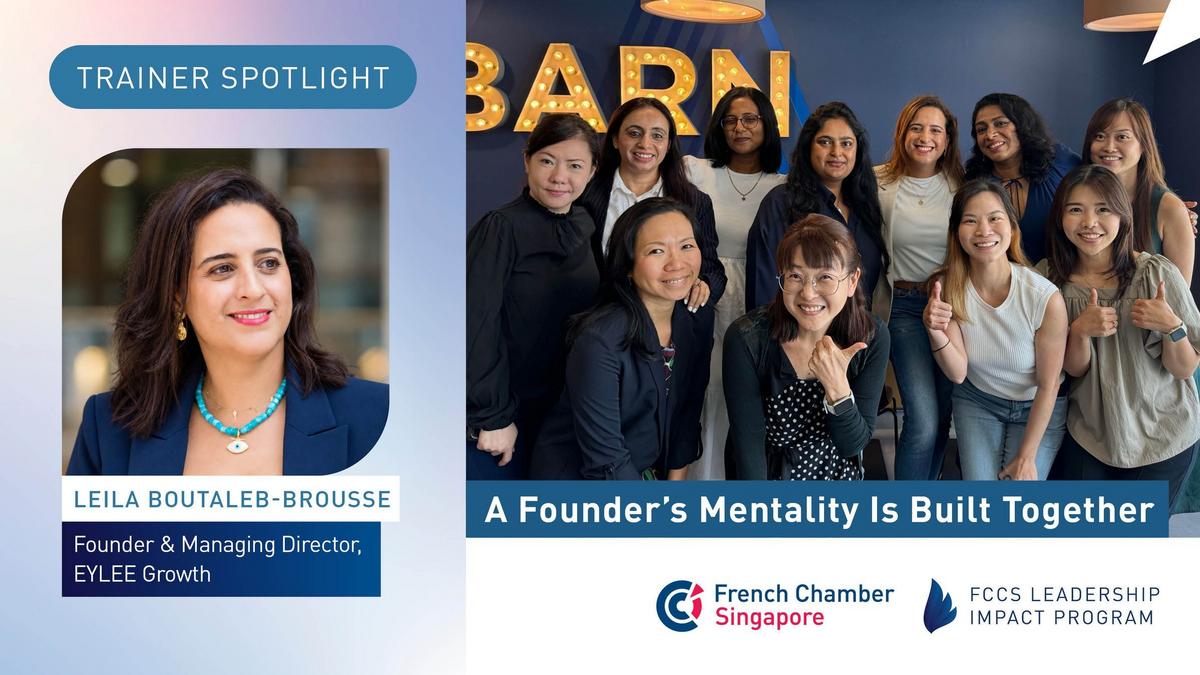
Leila Boutaleb-Brousse, Founder & Managing Director at EYLEE Growth gave an interview on her experience as a founder in the creation of concrete mentality and direction within her team.
You founded EYLEE Growth to help leaders and teams perform with greater clarity, confidence and resilience. How has your own entrepreneurial journey shaped your understanding of what it means to have a founder’s mentality?
My founder’s mentality began taking shape long before I founded EYLEE Growth. Throughout my corporate career, I was most energised when there was something to build: helping open a new market, growing a business unit or scale a business across the region.
I liked bringing people around a goal, making things happen and seeing the impact of our work. I found much more fulfilment in that than in simply running what was already in place.
That drive has served me well. It has also taught me some hard lessons. When you’re used to achieving, it’s easy to measure your worth by the latest result. And when you’re used to getting things done, it’s tempting to move fast and carry too much on your own. Building Eylee Growth has made me more aware of both.
Today, I see a founder’s mentality as the ability to hold a clear vision while dealing honestly with what’s in front of you. You make decisions and take action when things are still uncertain. You bring the right people in, make room for their ideas and take responsibility for the outcome.
That’s the mindset I try to bring to my own business and the leaders I work with. Ambition matters. So does the ability to keep learning, work with others and move forward when the path isn’t clear.
As organisations grow, what are some of the most common barriers that can weaken entrepreneurial thinking and a sense of ownership?
The biggest barrier is often fear. It can show up as self-doubt, perfectionism or the need to have every answer before taking action. In a growing organisation, it can also sound like, ‘That’s not my responsibility,’ or ‘I’d better wait until my manager tells me what to do.’ People may care deeply about the business, but fear of making a mistake or being criticised stops them from acting on what they see.
Leadership can make that fear stronger. Early in my career, as an intern at a large fashion company, I brought ideas to my manager. He told me, ‘I’m not asking you to reinvent the moon. Just do things the way we’ve always done them.’ I didn’t lose my drive to contribute, but I became very clear about the kind of culture I wanted to work in.
A founder’s mentality doesn’t mean everyone behaves like the founder or constantly comes up with new ideas. It means people understand what the organisation is trying to achieve, notice what needs attention, work with others to move it forward and take responsibility for the result.
That’s why, at EYLEE Growth, we work on both the individual and the team. We help leaders recognise the fear or pressure that makes them hold back or overcontrol. Then we work on the conditions their teams need: clear goals, trust, honest conversations and mutual accountability. You can ask people to take ownership, but your daily leadership has to give them a real chance to do it.
What is one common misconception about entrepreneurial leadership that you hope to reconsider during your session?
One misconception I’d like to challenge is that a team with an entrepreneurial mindset will be difficult to lead. Driven people have ideas, ask questions and want to act. For a leader, that can feel hard to manage, especially when people pull in different directions.
The problem isn’t that people have too much drive. It’s that drive alone doesn’t make a team. People need a shared goal, trust in one another and a clear sense of what they own together. They also need to be able to disagree and still commit to a decision.
That’s where our team training at EYLEE Growth comes in. We work with the whole team to clarify what they’re trying to achieve, build trust and turn ownership and mutual accountability into everyday behaviours. The leader sets the direction, but the team learns to carry it together.
That creates a multiplier effect. People spot problems earlier, act on opportunities and build on each other’s strengths. Progress comes from the team’s combined initiative, rather than one person having to push everything forward.
Leila Boutaleb-Brousse is one of the trainers of the FCCS Leadership Program, bringing her expertise in entrepreneurial thinking, team ownership and leadership directly to FCCS members.