Actus des entreprises
Schneider Electric backs NUS’ Sustainable Tropical Data Centre Testbed phase 2 on Jurong Island
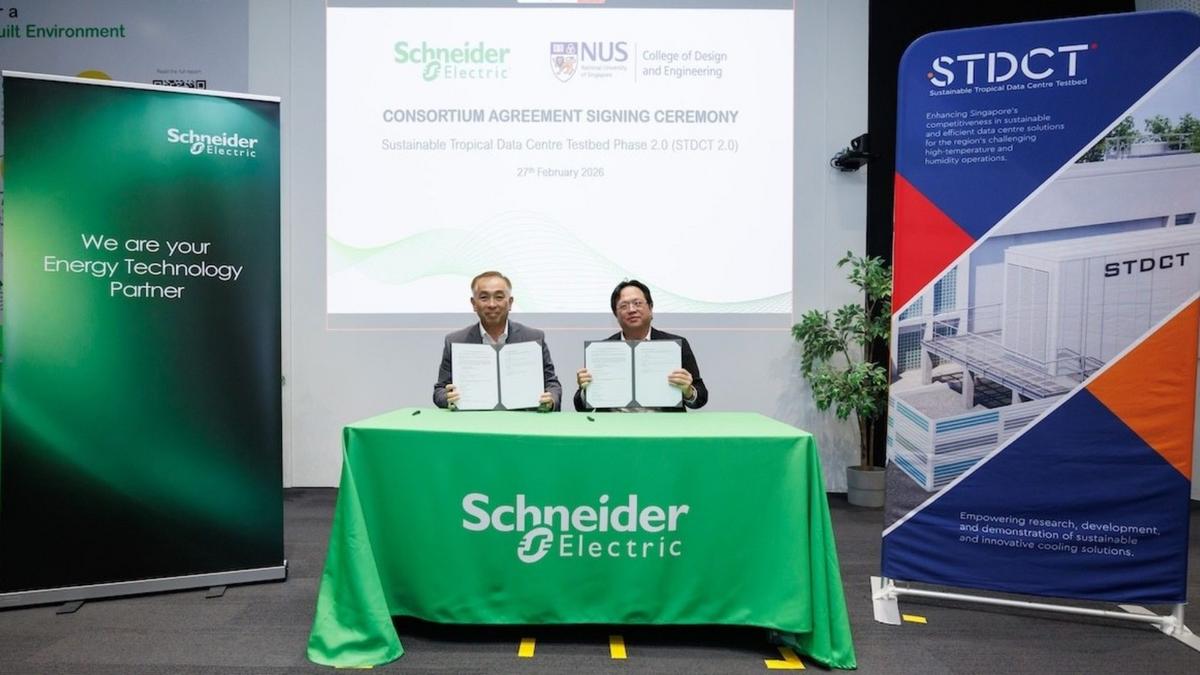
Schneider Electric Singapore is partnering with the National University of Singapore's (NUS) College of Design and Engineering (CDE) to develop and test data centre technologies suited to Singapore's tightening sustainability requirements.
The energy technology company has signed on as the first anchor sponsor of the Sustainable Tropical Data Centre Testbed Phase 2.0 (STDCT 2.0), a second-phase expansion of the university's tropical data centre testbed. It is also the first organisation to formalise a partnership under the programme.
Slated to begin this year, STDCT 2.0 will scale up from an original testbed launched in November 2023 into a multi-megawatt pilot facility on Jurong Island, within a 20-hectare zone earmarked for Singapore's largest low-carbon data centre park.
NUS signed a memorandum of understanding with JTC in November 2025 to anchor the STDCT 2.0 facility in an industrial precinct already home to hydrogen-ready power plants, sustainable fuels and carbon capture projects. The location is deliberate. Researchers intend to link data centre operations with surrounding industrial decarbonisation work, including waste-heat recovery and grid integration with low-carbon power sources.
The programme is shaped by a fast-moving hardware reality. Rack densities have surged from 5 to 10 kilowatts (kW) a few years ago to more than 200 kW today, driven by the heat output of AI accelerator chips. Speaking at an SGTech seminar on “Sustainable AI-ready data centres” on Feb 27, Professor Lee Poh Seng, head of Mechanical Engineering at NUS CDE and programme director of STDCT 2.0, says Nvidia's roadmap and recent Open Compute Project discussions point to densities of 600 kW per rack by next year, with some projections reaching one to four megawatts.
Lee argues that the conventional view of data centres as passive energy consumers needs to change. "If we build in flexibility, we are able to build in demand response, we are able to build in solutions that allow us to convert waste to resources. [That way], AI data centres can in fact enhance the resiliency of the [energy] grid," he says.
SOURCE: THE EDGE