Analyses & Etudes
The Algorithm and the Alchemist: navigating the wine & spirits industry in 2035

The strategic imperative of AI, E-commerce, and data collaboration.
Executive Summary: what is the 10-year future of the wine & spirits industry?
The global wine and spirits industry is on the cusp of a profound structural shift, driven by the maturation of Artificial Intelligence (AI) from a novelty feature to an indispensable operational and customer-facing infrastructure. By 2035, competitiveness will be defined not merely by the quality of the beverage, but by the efficiency, personalization, and transparency of the supply chain and consumer journey.
The synthesis of traditional craftsmanship with algorithmic precision—the intersection of the Alchemist and the Algorithm—is the central mandate for the coming decade.
Market analysis reveals a stable yet increasingly dynamic landscape. The Global Alcoholic Drinks market is poised to exceed $3.88 Trillion by 2035, maintaining a robust 9.2% Compound Annual Growth Rate (CAGR). This growth is heavily concentrated in digital channels, where wine e-commerce alone is projected to reach approximately $38.4 Billion by 2034, expanding at an explosive 33.6% CAGR. AI provides the only viable mechanism to manage the complexity and scale required by this exponential digital acceleration.
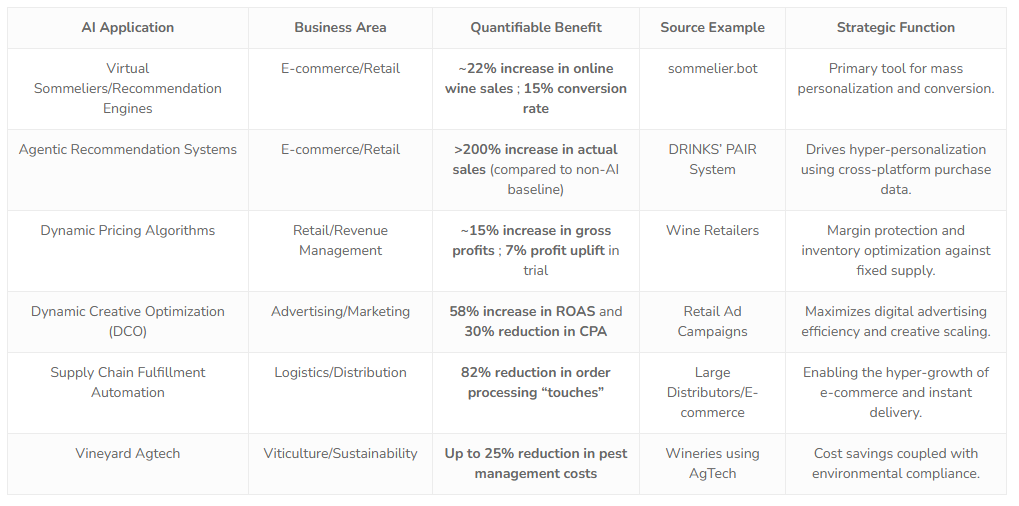
The return on investment (ROI) for advanced AI is already proven. Key applications have moved beyond pilot programs to deliver immediate, measurable improvements across the value chain. Agentic AI systems, designed to personalize consumer discovery, are driving a substantial ~22% increase in online sales and achieve conversion rates as high as 15% among users. Simultaneously, operational AI solutions, such as Dynamic Pricing algorithms adopted by nearly half of retailers, yield an estimated 7% to 15% uplift in gross profits.
However, the industry faces a critical, immediate threat: structural fragmentation and the prevalence of siloed merchant datasets. If independent producers and retailers fail to establish collaborative, merchant-owned data platforms, control over crucial customer taste profiles and market insights will be ceded to centralized, third-party gatekeepers. This would allow platforms like the Vivino model to levy disproportionate access taxes and potentially disintermediate traditional merchants.
To secure competitive advantage and maintain margin control through 2035, this report defines Five Strategic Imperatives, focused on establishing personalized engagement, operational efficiency, data collaboration, ethical trust, and workforce readiness.
Section I: The Market Thesis—2035: Growth, Premiumization, and the Digital Consumer
1.1 Global Market Trajectory and the Digital Growth Engine
The alcoholic beverage sector is experiencing sustained expansion driven by demographic shifts, premiumization, and global urbanization. Projections indicate that the overall Global Alcoholic Drinks market, estimated at $1.74 Trillion in 2026, is poised to surpass $3.88 Trillion by 2035, witnessing an impressive 9.2% CAGR during the forecast period. This resilience underscores the persistent global demand for experience and quality products.
The primary transformative force driving this market expansion is the accelerated migration of consumer behavior toward digital channels. The Global Wine E-commerce Market, valued at $2.8 Billion in 2025, is forecasted to soar to approximately $38.4 Billion by 2034, exhibiting a staggering 33.6% CAGR. This pace confirms that digital platforms are not merely supplemental but are the primary engine of new volume and consumer acquisition.
The rapid growth in e-commerce necessitates a radical rethinking of logistics. Quick market facts demonstrate that instant or on-demand wine delivery already accounts for 38.9% of the market share, indicating a strong consumer preference for speed and convenience over scheduled services. If this demand for rapid fulfillment is addressed using inefficient, traditional, multi-touch supply chains, the resulting operational costs would severely erode profitability. Therefore, the exponential growth of e-commerce is entirely contingent on the implementation of predictive AI routing and fulfillment automation—technologies that transition from optional enhancements to essential infrastructural requirements for sustainable, profitable digital growth.
Concurrent with volume growth is the enduring trend of premiumization. The global luxury wines and spirits industry, valued at $913.46 billion in 2025, is projected to reach $1.52 Trillion by 2035, registering a strong 5.25% CAGR. This segment thrives on authenticity, heritage, and story. Technology reinforces this value proposition: AI-driven image verification becomes crucial for luxury goods to prove provenance and combat the rising threat of counterfeits, thereby directly protecting the brand equity and supporting premium pricing models.
Table 1: Global Beverage Alcohol Market Trajectory (2025–2035)

Section II: AI from Grape to Glass—Mapping Durable Value vs. Digital Gimmicks
AI-driven technologies are delivering durable, transformative value by augmenting human decision-making, optimizing complex processes, and enhancing consistency across the entire supply chain. It is essential to distinguish these game-changing applications from novelty technologies that offer short-term media appeal but lack sustainable ROI.
2.1 The Production Revolution: AI Augmenting Craftsmanship
2.1.1 Viticulture and Climate Resilience
In the vineyard, AI provides indispensable insights to mitigate the severe risks posed by climate volatility. Startups like VineView utilize AI to analyze aerial imagery, generating real-time data on vine health, irrigation needs, and disease prevention. By processing vast image and sensor data, vineyard managers can apply corrective actions before significant damage occurs, leading to improved yield and reduced environmental impact.
The quantifiable impact is significant. Early adopters have demonstrated reductions in pest management costs by as much as 25% through precise application strategies. Furthermore, predictive AI models provide critical forecasts necessary for long-term planning, such as modeling climate scenarios or predicting smoke taint risk from wildfires, fundamentally protecting the quality and consistency of the harvest.
2.1.2 Precision in Fermentation and Distillation
AI technologies are establishing new benchmarks for consistency in the cellar and distillery. AI-driven fermentation monitoring tracks dozens of variables in real time, including pH level, dissolved oxygen, and yeast viability. This system reduces the risk of human error and ensures that batch consistency is maintained across various wine labels, even at the massive scale of operations like those at E. & J. Gallo Winery.
This vigilance has a direct effect on quality. AI-based fermentation control has been credited with improving overall wine quality scores by approximately 15% (as of today we do not know whether it is actual AI or ML). In distilling, AI monitors production processes to maintain quality and detect batch inconsistencies, with advanced systems capable of identifying whisky brands with over 99% accuracy using spectroscopy combined with machine learning.
2.1.3 AI in New Product Development (NPD)
AI is increasingly utilized to analyze complex flavor profiles and accelerate the creation of novel products. By mining large datasets of flavors and consumer preferences (including social media and menu trends), AI can inform blending decisions that might defy traditional assumptions. Case studies include Mackmyra’s “Intelligens” whiskey, created using an AI-generated recipe, and Diageo’s successful use of AI to predict rising flavor interest—leading to products like Buchanan’s Pineapple Scotch, which capitalized on predicted demand for fruity profiles in Scotch.
For winemakers and distillers, the technology allows their role to evolve into that of an “AI Conductor.” The AI handles the high-volume data collection, analysis, and process vigilance, enabling the human expert to spend less time in front of a spreadsheet and more time focusing on the art of blending, sensory judgment, and intuitive adjustments. The AI complements, rather than replaces, the craft, allowing winemakers to refine their art while respecting age-old traditions.
2.2 The Retail Tipping Point: Personalized Agentic AI at Scale
The most impactful commercial application of AI is the personalization of discovery, which addresses the consumer “paralysis of choice.”
Industry analysis reveals that 61% of consumers feel overwhelmed or confused when buying wine in a supermarket, leading 42% to simply choose by price as their deciding factor. Agentic AI systems provide the solution, operating as an autonomous, knowledgeable personal shopper that manages the complex discovery process on the customer’s behalf, effectively replicating the specialized guidance of a human sommelier for every single customer at scale.
2.2.1 The Virtual Sommelier ROI (Agentic Focus)
The rapid adoption of conversational recommenders is justified by clear, measurable returns. Industry-specific, customizable Software-as-a-Service (SaaS) Agentic platforms, such as the leading AI Wine & Spirits agent: sommelier.bot, move beyond simple chatbots. They act as sophisticated personal agents, developing a persistent taste graph by analyzing past orders and real-time interaction history across multiple channels. This Agentic approach allows the system to set goals, plan, and execute personalized recommendations autonomously, achieving an impressive 23% click-through rate in trials and an overall 15% conversion rate among users. This level of precision is driving substantial results, with AI recommendation engines having already boosted online wine sales by approximately 22%. The value is magnified when agents utilize sophisticated data inputs. For instance, Predictive Artificial Intelligence Retailing (PAIR) systems have shown an increase in actual sales by over 200% compared to non-AI-enabled suggestions by analyzing billions of privacy-protected data points, including inferred customer behavior and purchase history across platforms.
A critical success factor for these systems is the ability to maintain a persistent taste profile across multiple channels, adapting recommendations based on past orders, conversation history, and stated preferences, whether the shopper is engaging on a website, a mobile app, or interacting with a smart kiosk in a physical store. Customizable Agentic tools allow merchants to integrate these capabilities directly into their own inventory systems, enabling continuous improvement and the development of new, specialized features over time.
2.2.2 Generative AI in Marketing and Design
Generative AI tools are becoming commonplace for accelerating low-stakes creative tasks. Producers, such as Napa’s Silver Ridge winery, have used AI to generate label designs, reducing design time from weeks to days. Spirits brands like Martini have utilized Midjourney for botanical-themed advertising visuals. While these applications enhance speed and creative iteration, they primarily serve as moderate innovation depth tools, leveraging existing generative models. It is crucial that these tools are used with strict human oversight to ensure compliance and maintain authenticity, especially in light of forthcoming labeling requirements for AI-generated content.
Z Digital Agency (a Swiss marketing agency) anticipates a complete automation of both visual and video creatives by 2035. The effect will be to level the playing field for almost all players, making it a must-have to stand out with truly personalized and creative contents.
2.3 Digital Advertising: The Age of Dynamic Creative and the AI Shopper
The convergence of Generative AI and Agentic AI is fundamentally reshaping the relationship between brands and consumers, signaling the end of traditional keyword-based digital marketing.
2.3.1 Dynamic Creative Optimization (DCO)
AI is moving beyond simple audience targeting to personalize the creative assets themselves. Dynamic Creative Optimization (DCO) systems use real-time data to automatically generate and adapt thousands of personalized ad variations based on the shopper’s location, time of day, weather, and known preferences. This precision targets the high-value luxury sector and the fast-moving consumer goods segments, delivering exceptional efficiency. DCO efforts have demonstrated quantifiable returns: one case study achieved a 58% increase in Return on Ad Spend (ROAS) and a 30% reduction in Cost Per Acquisition (CPA) by using dynamic video personalization. Furthermore, deep learning recommendation algorithms are proven to increase average revenue per user by 88% through personalization.
2.3.2 The Autonomous Agent Threat to SEO
The rise of Agentic AI, which can autonomously shop and negotiate on a consumer’s behalf, presents a strategic threat to the traditional retail model reliant on Search Engine Optimization (SEO). Autonomous AI agents act as hyper-efficient personal shoppers—performing the research, comparing prices across sites, and even validating the shopping basket.
For retailers, this means that product discovery will increasingly happen inside the Agent, bypassing traditional search engines, comparison sites, and brand websites. This shift means organic traffic generated by traditional SEO will diminish in value, as consumers delegate discovery to their AI. While currently AI accounts for less than 1% of total e-commerce traffic, it already accounts for up to 25% of referral traffic for some retailers! Retailers must shift their strategy from optimizing for search engines to optimizing for the AI Agent itself, ensuring product data is standardized and accessible for Agent consumption (often referred to as ‘AI SEO’). Failure to optimize for these autonomous agents risks commoditizing products and ceding control over the customer relationship to the Agent’s platform.
2.4 Operational Efficiencies: AI Protecting Fragile Margins
In a low-margin, price-sensitive market, AI delivers necessary operational precision to protect profitability and manage complex inventory flows.
2.4.1 Dynamic Pricing as Margin Defense
The reality of wine and spirits supply is that it is often fixed or “sticky” in the short term, requiring pricing strategies to adjust to fluctuating demand curves. AI-driven dynamic pricing algorithms calculate optimal pricing points in real-time based on demand, stock levels, competitor prices, and external factors like weather.
This technology is moving into the mainstream, with nearly 49% of wine retailers reporting its use.1 Dynamic pricing has increased profit margins by an estimated 15% on average. A controlled case study involving an online wine retailer demonstrated that a dynamic pricing strategy based on real-time supply and demand outperformed a traditional cost-based pricing strategy, yielding a 5% increase in revenue and a 7% increase in gross profits in the test region.
2.4.2 Predictive Logistics and Fulfillment Automation
For global giants and high-volume e-commerce platforms, AI is foundational to streamlining supply chains. Companies like Heineken use machine learning for demand forecasting, enabling precise allocation and route optimization. AB InBev utilizes geospatial data combined with AI to dynamically map customer outlets and tailor distribution efforts, ensuring stock is preemptively moved to locations at risk of stockouts.
Crucially, in fulfillment centers, automation guided by AI radically improves scalability and protects fragile products. High-volume e-commerce operations have demonstrated that optimized processes can lead to an 82% reduction in the number of “touches” required to process e-commerce orders, dropping the handling count from 29 down to 5. This extreme efficiency is the engine that enables the forecasted hyper-growth of e-commerce by minimizing labor cost, waste, and breakage risk.
Table 2: Quantifiable ROI of Key AI Applications (Mid-2020s Data)

Section III: Structural Challenges—Solving Fragmentation, Trust, and the Talent Gap
While the technology for transformation exists, three structural challenges must be overcome to realize the full potential of AI by 2035: data fragmentation, the consumer trust deficit, and a pronounced digital talent gap.
3.1 The Network Effect Challenge: Data Fragmentation and Ownership
The wine industry’s traditional fragmentation—thousands of small-to-medium enterprises operating in silos—is the greatest barrier to leveraging AI. Effective, high-performance AI models thrive on extensive data sets, a resource individual merchants lack. This is the “network effect challenge”: a lone merchant’s AI project often fails because it cannot glean meaningful behavioral patterns from limited data.
This situation creates a critical competitive disadvantage. If data remains captive or is consolidated only by large technology platforms like Vivino, those gatekeepers gain control over the most valuable asset—the customer taste graph. Independents risk losing leverage and customer ownership, becoming reliant on systems they do not govern.
The strategic answer to fragmentation is horizontal data collaboration. The imperative is to form or join merchant consortiums to pool anonymous customer data, co-fund shared AI models, and standardize product attributes. This cooperative approach allows smaller players to access the richer insights drawn from millions of data points, ensuring that the network effect benefits the merchant community collectively. This model of data sharing is already proving successful in achieving collaborative logistics and planning in complex European supply chain sectors.
3.2 The Trust Deficit: Ethical AI and Regulatory Compliance
The wine and spirits industry trades on authenticity, heritage, and human passion. The introduction of AI raises a fundamental concern: the authenticity crisis. Consumers may doubt the credibility of tasting notes or product claims if they suspect the content was written purely by a machine, rather than a human expert.1 Studies confirm that high-end buyers prefer descriptions from real sommeliers, suggesting that transparency is essential.
To mitigate this, the implementation of a Human-AI Hybrid approach is essential, ensuring human editors review AI-generated content, claims, and sensitive customer replies.26 Consumers are more accepting of AI guidance when the source is reputable and clearly mediated by human experts. Non-transparent practices and excessive automation have been shown to dampen consumer satisfaction and loyalty.
Moreover, the regulatory environment is rapidly catching up to technology. The EU AI Act, the first comprehensive legal framework on AI, is setting global standards, with key provisions for high-risk systems beginning application by December 2027. This regulation emphasizes transparency and bias mitigation. Ethical AI Governance, ensuring compliance with data protection laws like GDPR and CCPA, is vital. Brands that prioritize transparency—such as labeling AI-generated content and using Explainable AI to show customers why a recommendation was made—build crucial loyalty and trust, as non-transparent practices and excessive automation have been shown to dampen consumer satisfaction.
Finally, AI must be a guardian of authenticity. Fraudsters may use deepfakes or AI to create counterfeit reviews or labels. Conversely, AI image recognition provides a potent defense, helping distributors spot counterfeit bottles by analyzing label micro-details and verifying serial codes. AI transforms from a potential threat to authenticity into a critical tool for protecting provenance in the premium sector.
3.3 The Digital Talent Imperative: Upskilling for Collaboration
A pervasive digital talent gap exists across the sector. Many small and medium-sized businesses, historically focused on analog, relationship-driven processes, lack the in-house engineers and data scientists needed to harness advanced AI.22 Companies that cannot adapt risk falling significantly behind, while those that attempt implementation without adequate knowledge may misapply AI systems.
The future solution is not AI replacement, but human augmentation. AI will not displace experienced sommeliers or sales agents; instead, it will handle routine queries, complex data processing, and initial recommendations, freeing human professionals to focus on high-level service, personal storytelling, and curation.
The industry conclusion is clear: “AI won’t replace people, but people who use AI may replace those who don’t”.
Many companies will try to integrate AI-solutions in-house to cut costs and have proprietary solutions, while actually lacking the relevant in-house AI expertise, leading to half-backed initiatives. On the contrary SaaS solutions like the sommelier.bot wine Agent will provide a quick and cost-effective solution, mutualizing data & industry-specific expertise across merchants.
The required organizational adaptation involves implementing dedicated task-force-like structures to drive scalable, trustworthy initiatives and govern security and compliance. Successful implementation also demands cross-collaboration across departments, including IT, Legal, and Data Science, ensuring that AI tools are adopted through effective change management. The sommelier of 2035 must be adept at working with AI systems, blending deep wine expertise with digital fluency to elevate the customer experience.
Section IV: The 2035 Consumer Journey—The Virtual Cellar and Seamless Retail
The intersection of Agentic AI, ubiquitous connectivity, and advanced logistics will converge to create a hyper-personalized and efficient consumer experience by 2035, regardless of whether the purchase is made online or in-store.
4.1 The Next-Gen E-Commerce Experience
Online sales will transition from manual keyword searches to natural, conversational discovery (still based on contexts coming from the initial keywords based searches). Consumers will engage with voice assistants or text interfaces, providing complex, contextual input, such as: “I’m grilling lamb chops tonight, what Malbec or low-tannin wine pairs best with my delivery order of spicy Sichuan food?”. The Agentic AI instantly consults the user’s universal taste graph and returns 2–3 precise, personalized options.
Key to this seamless experience is Persistent Preference Architecture. The AI agent maintains a cross-site taste memory for the user, recalling past orders, conversation history, and stated preferences to refine future matches. For truly seamless engagement, customizable agents like sommelier.bot will greet returning shoppers by name, immediately referencing their last conversations, cart contents, and recent purchase history, ensuring the service is hyper-relevant and continuous. Furthermore, compliance barriers that currently plague online alcohol sales (age verification, locale restrictions) will be automatically handled by secure digital ID checks and AI-driven content localization, significantly simplifying cross-border demand.
4.2 The Transformation of Physical Retail
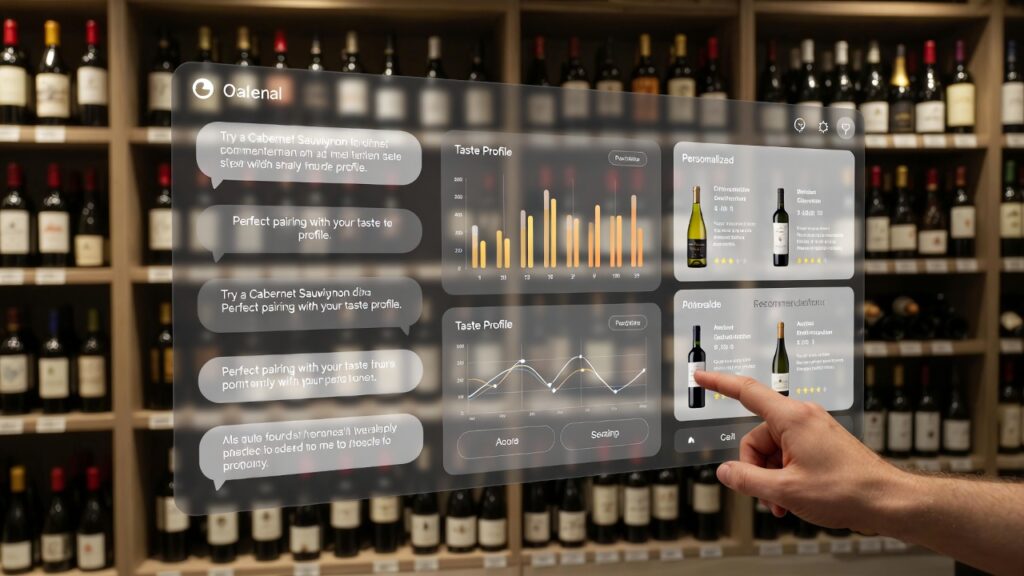
Physical retail locations will be fundamentally transformed into intelligent, curated experiences—the “Living Store.” Upon customer opt-in (via loyalty app or phone sync), smart digital shelf displays will activate, delivering dynamic pricing and personalized product suggestions tailored to the individual standing in the aisle.
Human staff will be the beneficiaries of this technology. Freed from the burden of memorizing vast product data, staff will use AI tablets to access customer profiles and detailed “cheat sheets” (instantly generated tasting notes, pairing suggestions, production facts) for any bottle they scan.1 This shifts the staff’s focus entirely to hospitality, complex problem solving, and compelling, informed storytelling, ensuring the human element of service is elevated. For routine, expert-level queries when staff are busy, strategically placed Agentic smart kiosks—running advanced conversational AI like sommelier.bot—will provide instant, knowledgeable guidance, fulfilling the ultimate realization of the human-AI hybrid service model.
4.3 The Logistics Game-Changer: The Virtual Cellar Model
The logistics model of 2035 will center on Single-Touch Fulfillment enabled by the Virtual Cellar concept. This is the crucial answer to the high costs, breakage risks, and environmental impact associated with the traditional multi-touch distribution system.
4.3.1 Model Mechanics and Efficiency
The Virtual Cellar allows customers to purchase bottles across multiple integrated shops, but the physical stock is maintained in centralized, AI-optimized fulfillment hubs, where the inventory is virtually stored. The critical difference is that inventory only moves once: the order delivery is triggered (e.g., at a 12-bottle threshold), and the stock moves directly from the producer’s original pallet at the central hub straight to the customer’s door.
This radical consolidation offers a triple value proposition:
- Cost Efficiency: By reducing the number of manual handling points (“touches”), companies realize massive savings. High-efficiency fulfillment centers have already reduced order processing touches by 82%.21 Furthermore, freight consolidation reduces costs for importers by allowing them to pay only for the space used, keeping inventory leaner and freeing up cash.
- Consumption habits: City-based consumers have a tendency to purchase and store at home fewer bottles than the previous generations. They feel overwhelmed with 6 bottles at home. An outsourced, on-demand cellar with fast delivery is the solution for them.
- Sustainability: Consolidated shipments and AI-optimized routing are vital for achieving sustainability targets. Increased delivery lead times allow for better route utilization, fewer trips, and a reduction in greenhouse gas (GHG) emissions from fuel combustion, addressing the growing consumer preference for greener delivery options.
This optimized model, enabled by AI, is the infrastructural foundation that will sustain the projected 33.6% CAGR in e-commerce, ensuring speed and convenience are achieved profitably.
Section IV: The 2035 Consumer Journey—The Virtual Cellar and Seamless Retail
The intersection of Agentic AI, ubiquitous connectivity, and advanced logistics will converge to create a hyper-personalized and efficient consumer experience by 2035, regardless of whether the purchase is made online or in-store.
4.1 The Next-Gen E-Commerce Experience
Online sales will transition from manual keyword searches to natural, conversational discovery (still based on contexts coming from the initial keywords based searches). Consumers will engage with voice assistants or text interfaces, providing complex, contextual input, such as: “I’m grilling lamb chops tonight, what Malbec or low-tannin wine pairs best with my delivery order of spicy Sichuan food?”. The Agentic AI instantly consults the user’s universal taste graph and returns 2–3 precise, personalized options.
Key to this seamless experience is Persistent Preference Architecture. The AI agent maintains a cross-site taste memory for the user, recalling past orders, conversation history, and stated preferences to refine future matches. For truly seamless engagement, customizable agents like sommelier.bot will greet returning shoppers by name, immediately referencing their last conversations, cart contents, and recent purchase history, ensuring the service is hyper-relevant and continuous. Furthermore, compliance barriers that currently plague online alcohol sales (age verification, locale restrictions) will be automatically handled by secure digital ID checks and AI-driven content localization, significantly simplifying cross-border demand.
4.2 The Transformation of Physical Retail
Physical retail locations will be fundamentally transformed into intelligent, curated experiences—the “Living Store.” Upon customer opt-in (via loyalty app or phone sync), smart digital shelf displays will activate, delivering dynamic pricing and personalized product suggestions tailored to the individual standing in the aisle.
Human staff will be the beneficiaries of this technology. Freed from the burden of memorizing vast product data, staff will use AI tablets to access customer profiles and detailed “cheat sheets” (instantly generated tasting notes, pairing suggestions, production facts) for any bottle they scan.1 This shifts the staff’s focus entirely to hospitality, complex problem solving, and compelling, informed storytelling, ensuring the human element of service is elevated. For routine, expert-level queries when staff are busy, strategically placed Agentic smart kiosks—running advanced conversational AI like sommelier.bot—will provide instant, knowledgeable guidance, fulfilling the ultimate realization of the human-AI hybrid service model.
4.3 The Logistics Game-Changer: The Virtual Cellar Model
The logistics model of 2035 will center on Single-Touch Fulfillment enabled by the Virtual Cellar concept. This is the crucial answer to the high costs, breakage risks, and environmental impact associated with the traditional multi-touch distribution system.
4.3.1 Model Mechanics and Efficiency
The Virtual Cellar allows customers to purchase bottles across multiple integrated shops, but the physical stock is maintained in centralized, AI-optimized fulfillment hubs, where the inventory is virtually stored. The critical difference is that inventory only moves once: the order delivery is triggered (e.g., at a 12-bottle threshold), and the stock moves directly from the producer’s original pallet at the central hub straight to the customer’s door.
This radical consolidation offers a triple value proposition:
- Cost Efficiency: By reducing the number of manual handling points (“touches”), companies realize massive savings. High-efficiency fulfillment centers have already reduced order processing touches by 82%.21 Furthermore, freight consolidation reduces costs for importers by allowing them to pay only for the space used, keeping inventory leaner and freeing up cash.
- Consumption habits: City-based consumers have a tendency to purchase and store at home fewer bottles than the previous generations. They feel overwhelmed with 6 bottles at home. An outsourced, on-demand cellar with fast delivery is the solution for them.
- Sustainability: Consolidated shipments and AI-optimized routing are vital for achieving sustainability targets. Increased delivery lead times allow for better route utilization, fewer trips, and a reduction in greenhouse gas (GHG) emissions from fuel combustion, addressing the growing consumer preference for greener delivery options.
This optimized model, enabled by AI, is the infrastructural foundation that will sustain the projected 33.6% CAGR in e-commerce, ensuring speed and convenience are achieved profitably.
SOURCE: SOMMELIER.BOT