Interview • Portraits
Trainer Spotlight | How Your Team Feels Is How Your Team Performs
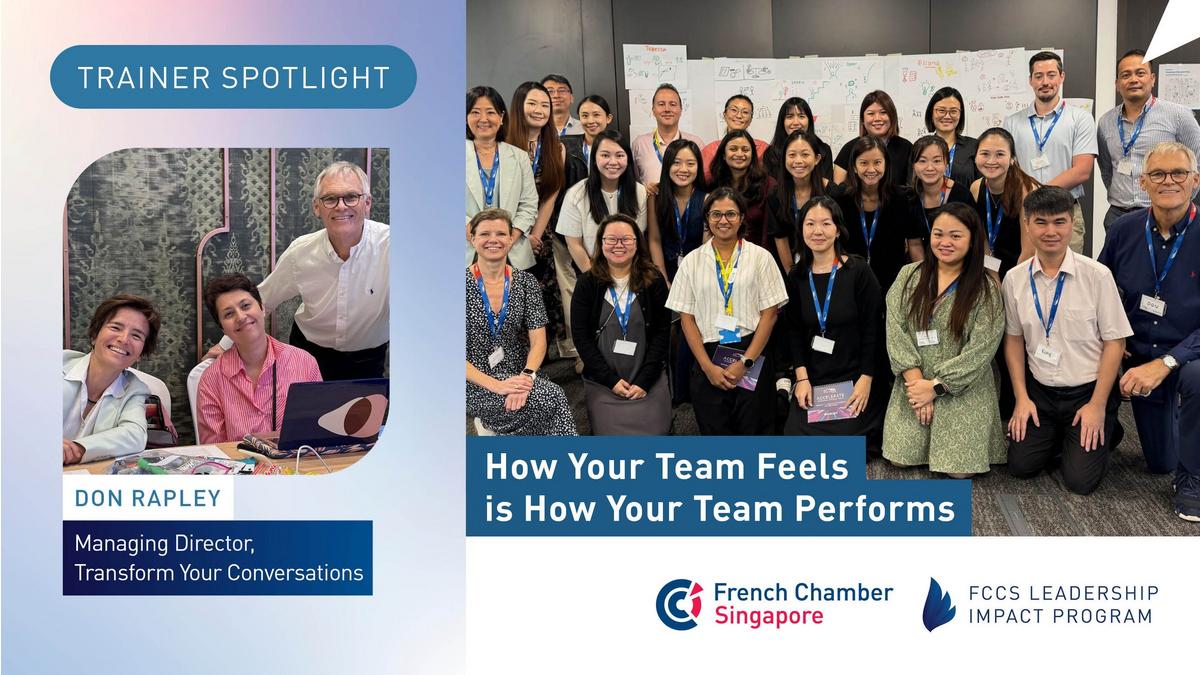
Don Rapley, Managing Director at Transform Your Conversations, shares how trust-based conversations are reshaping leadership and collaboration today.
From your perspective, what makes workplace conversations truly effective in driving collaboration and performance?
How your team performs is driven by how they feel. Think about a team you have been part of where people genuinely spoke up, where anyone could say “I don’t know” or “I don’t agree” without fear. Now think about one where that didn’t happen. What was the real difference? It wasn’t skills or talent, it was how people felt.
Three things, in my experience, make conversations truly effective:
- Psychological safety: Amy Edmondson’s research, confirmed by Google’s Project Aristotle across 180 teams, shows the number one predictor of team success is whether people feel safe to speak up, openly admit mistakes and challenge assumptions. In your conversations, you’re either building it or eroding it, often without realising.
- Listening: Simon Sinek puts it simply: the most powerful thing you can do for another person is make them feel heard … and they will trust you. Not just listened to, but genuinely heard. This means having real curiosity about what your team thinks, asking incisive questions and leaving space for the answer.
- Trust: When your team feel safe being vulnerable with you, trust grows and engagement follows. That happens when your focus is on them, not on yourself.
Can you share a concrete example of how leaders can use everyday conversations to build trust and engagement within their teams?
The research is clear and I’ve seen it consistently: frequent conversations are essential and make a big difference. Once or twice a year is no longer enough.
But not all conversations look the same. Some need real preparation, with clear objectives, a sense of how you want the other person to feel and questions you’ve actually thought through.
In our work at TYC, we use a Conversation Planner to help leaders prepare for all types of performance, development or feedback conversations.
Other conversations need to be more open. No agenda. Just: “What’s on your mind, or what’s the challenge?” And then genuinely listen, with no fixing the problem yourself, no filling the silence, leaving space for the person to think through the challenge for themselves.
You will be leading a session of the FCCS Leadership Programme on Delegation, Empowerment and Managing Performance. What is the most critical mindset shift leaders need to make today to lead their teams more effectively?
Dan Pink’s research tells us what really motivates and engages people is Autonomy, Mastery and Purpose. The mindset shift is this: moving from managing outputs to creating the conditions for people to thrive. Giving them real autonomy, supporting their growth and connecting their work to a bigger purpose.
The tension I explore in my training sessions is the balance between intervening and stepping back. You need both control and autonomy, but overdoing either one is where engagement drops and performance suffers.
The shift I want every leader in the FCCS group to make: stop asking “How do I keep this on track?” and start asking “How do I help this person take real ownership?” That conversation changes everything.
DON RAPLEY is one of the trainers of the FCCS Leadership Programme, bringing his expertise in leadership conversations, delegation and performance directly to FCCS members.