

Comité
Artificial Intelligence in the Legal Industry: Opportunities and Challenges
K&L Gates Straits Law LLC,
9 Raffles Pl, #32-00 Republic Plaza, 049315, Singapore
Voir sur la carte
Langue(s) de l'événement
English
Member of the In-House Counsel Club? Join our upcoming session around AI in the legal industry
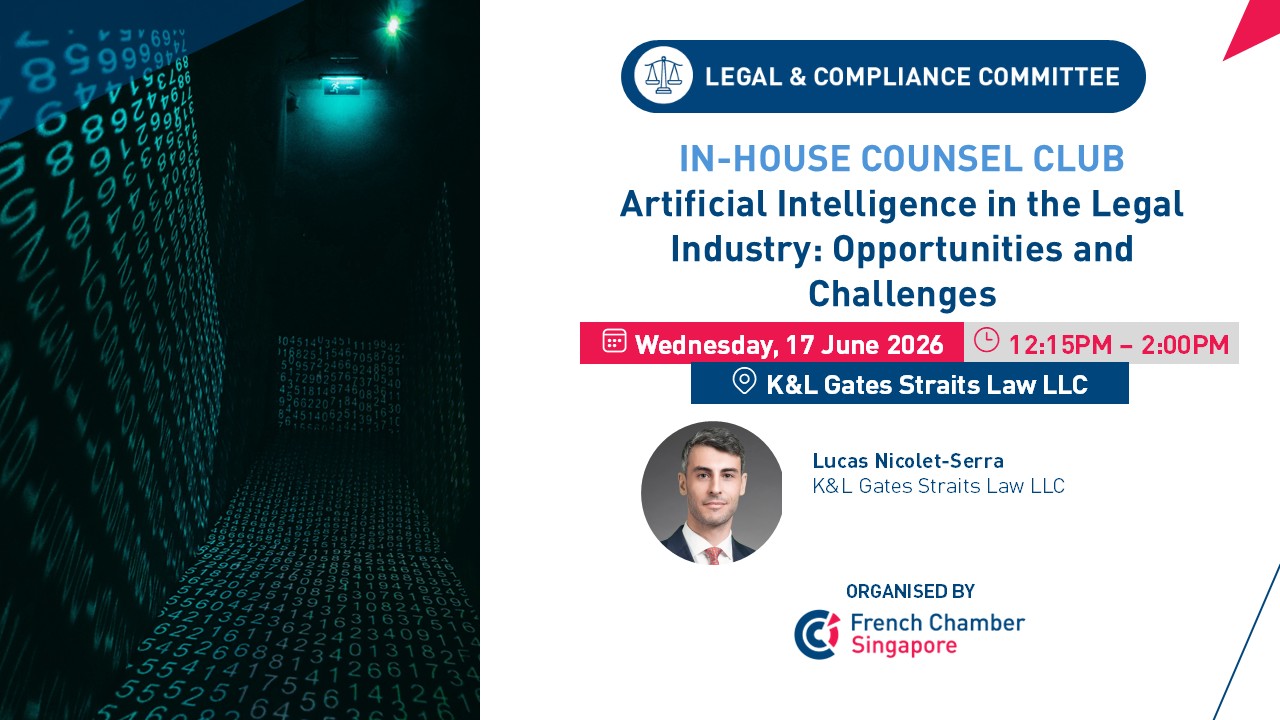
Artificial intelligence is rapidly reshaping the legal profession, transforming how legal services are delivered, how law firms operate, and how in-house teams manage risk and compliance. From contract review and legal research to predictive analytics and generative drafting, AI is becoming embedded in everyday legal workflows and is expected to have a transformative impact on the practice of law in the coming years.
This session, led by Lucas Nicolet-Serra, K&L Gates Straits Law LLC, will bring together in-house counsels to explore the practical opportunities and emerging risks associated with AI adoption in the legal sector.
The following topics will be covered:
Key Opportunities
- Efficiency and productivity gains: AI-powered tools can automate repetitive tasks such as document review, due diligence, and legal research, allowing lawyers to focus on higher-value strategic work.
- Enhanced decision-making: Advanced analytics and natural language processing enable faster and more informed legal analysis, improving outcomes for clients.
- New service delivery models: AI is driving innovation in legal services, including digital platforms, smarter workflows, and more scalable support for cross-border matters.
- Improved access to justice: Technology-enabled solutions can expand access to legal information and services, particularly for underserved communities.
Key Challenges and Risks
- Ethical and professional responsibility: Lawyers must ensure appropriate human oversight, maintain independence of judgment, and comply with professional standards when using AI.
- Data privacy and confidentiality: The use of AI raises critical issues around client confidentiality, data security, and cross-border data transfers.
- Bias, accuracy and reliability: AI systems may produce biased or inaccurate outputs (“hallucinations”), requiring robust validation processes and governance frameworks.
- Regulatory uncertainty: The evolving global regulatory landscape (e.g., EU AI Act and other frameworks) creates complexity for legal teams operating across jurisdictions.
- Impact on business models and talent: AI challenges traditional billing structures and requires new skills, training, and organizational approaches.
Modalités d'accès