Bilans d’évènement
Past Event | “The PFAS Imperative: ESG Governance and Corporate Resilience”
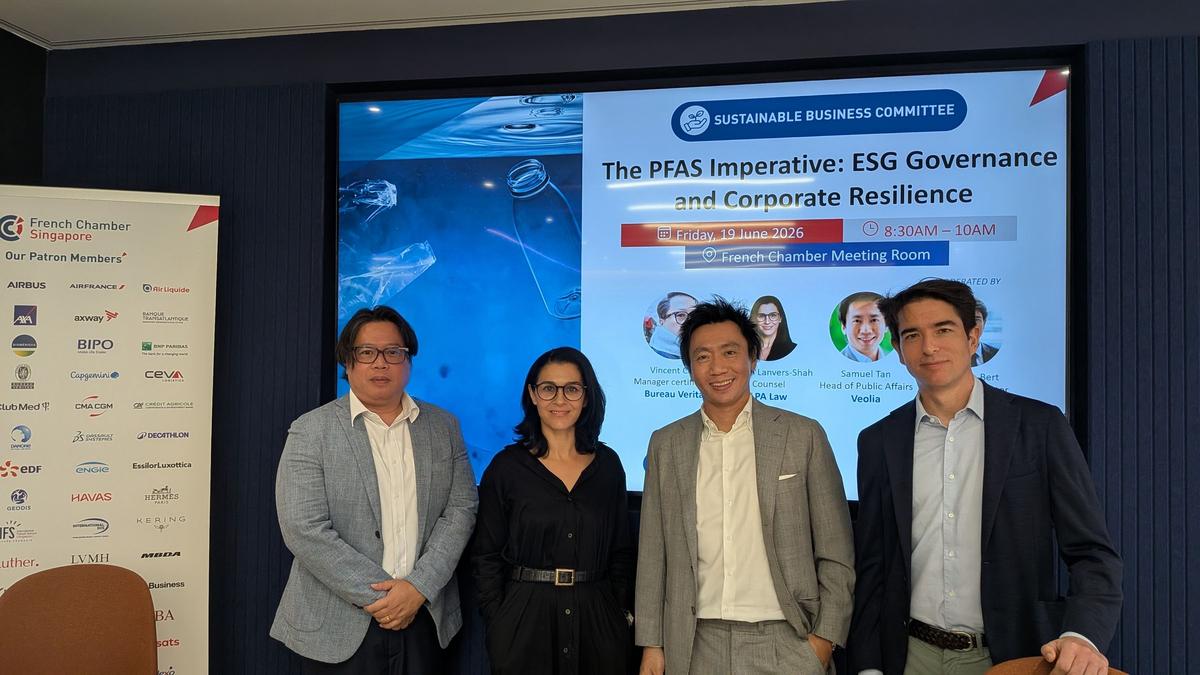
Throwback on our latest Sustainable Business Committee meeting “The PFAS Imperative: ESG Governance and Corporate Resilience”, supported by our Committee Partner ENGIE.
As global regulators accelerate the phase-out of PFAS, industry leaders face the critical challenge of reconciling tightening international standards with complex global supply chains. Addressing this shift, our panel of esteemed experts: Lisbeth Lanvers-Shah (LPA Law), Vincent Chng (Bureau Veritas), and Samuel Tan (Veolia), moderated by Dimitri Le Bert (PwC) - provided actionable insights on how businesses can proactively secure supply chains, protect corporate reputation, and drive long-term ESG.
Key Takeaways:
From Chemical Concern to Boardroom Liability: PFAS is now the largest environmental liability wave since asbestos. European precedents show that courts are sentencing individual executives, not just fining corporations, when chemical risks are ignored.
The Contractual Trap for Asian Exporters: While regional ASEAN legislation is still 3–5 years away, exposure for local firms is immediate via European supply contracts. Exporters face severe risk through strict "PFAS-free" warranties; a single failed test can trigger product rejections, customs seizures, and total contract termination.
Navigating the "Singapore Benchmark": Singapore regulates PFAS via the Environmental Protection and Management Act (EPMA). Firefighting foam restrictions began a phased roll-out on January 1, 2026, and Long-Chain Perfluorocarboxylic Acids (LC-PFCAs) face a full ban on December 16, 2026.
Operational Realities & Traceability: To maintain market access, companies must adopt verified traceability and rely on accredited laboratory testing to create a robust audit trail across all supply tiers. However, no company can credibly claim to be “PFAS-free”: testing for all 10,000+ compounds is scientifically impossible, and unsubstantiated marketing claims may expose businesses to serious greenwashing litigation.
The panel concluded that the challenge has shifted from a pure environmental concern into a broader matter of governance, contractual integrity, and overall business resilience. Ultimate success belongs to the companies that proactively map and verify their exposure before external parties demand it, prompting organizations to take immediate, practical action by starting with their existing resources and doing whatever is currently within their means.
Should you have any questions on the event or on our Sustainable Business Committee, please kindly contact Alexia Duvernoy at aduvernoy(@)fccsingapore.com